Pool water loss is one of the most frustrating diagnostic challenges Plymouth pool owners face. Is it evaporation? Is it a leak? And if it’s a leak, where exactly is it? Professional pool leak detection in Plymouth, MA answers these questions systematically — using pressure testing, dye testing, and inspection to locate leak sources precisely before any repair dollars are committed. This guide covers how professional pool leak detection works in Plymouth, what it costs, the most common leak types found in Plymouth-area pools, and what the repair process involves.
The Bucket Test: Your First Diagnostic Step
Before scheduling professional leak detection, Plymouth pool owners can perform the bucket test — a simple, free first step. Fill a plastic bucket with pool water, set it on pool steps at the same water temperature as the pool, mark both the bucket and pool water level with tape or a marker, and check both marks after 24 hours. Run the test with the pump on and again with the pump off — the results can indicate whether the leak is in the pressurized plumbing or the passive pool structure.
If pool and bucket drop the same amount — evaporation, no leak. If pool drops more than the bucket — a leak is indicated. The pump-on vs. pump-off differential is informative: pool losing water only with pump running suggests a pressurized return line or fitting leak; loss only with pump off suggests a suction line, skimmer, or shell crack; constant loss regardless of pump state suggests a shell leak or passive component failure (light niche, main drain).
A pool losing ½ inch per day more than the bucket is losing roughly 200+ gallons daily on a standard pool — a significant but not unusual residential leak rate. This represents tens of thousands of gallons over a swim season, plus the cost of chemicals to balance each top-off.
How Professional Leak Detection Works in Plymouth
Cape Cod Pool Repair’s leak detection process is systematic and designed to answer three questions definitively: Is there a leak? Where is it located? What is the correct repair?
Visual inspection. The technician inspects all accessible components — skimmer throat, return fittings, light niche, main drain cover, coping and tile for water damage indicators, and all equipment pad fittings and unions. Wet soil patches outside the pool perimeter, algae growth patterns, and staining near fittings all provide diagnostic information before any testing equipment is deployed.
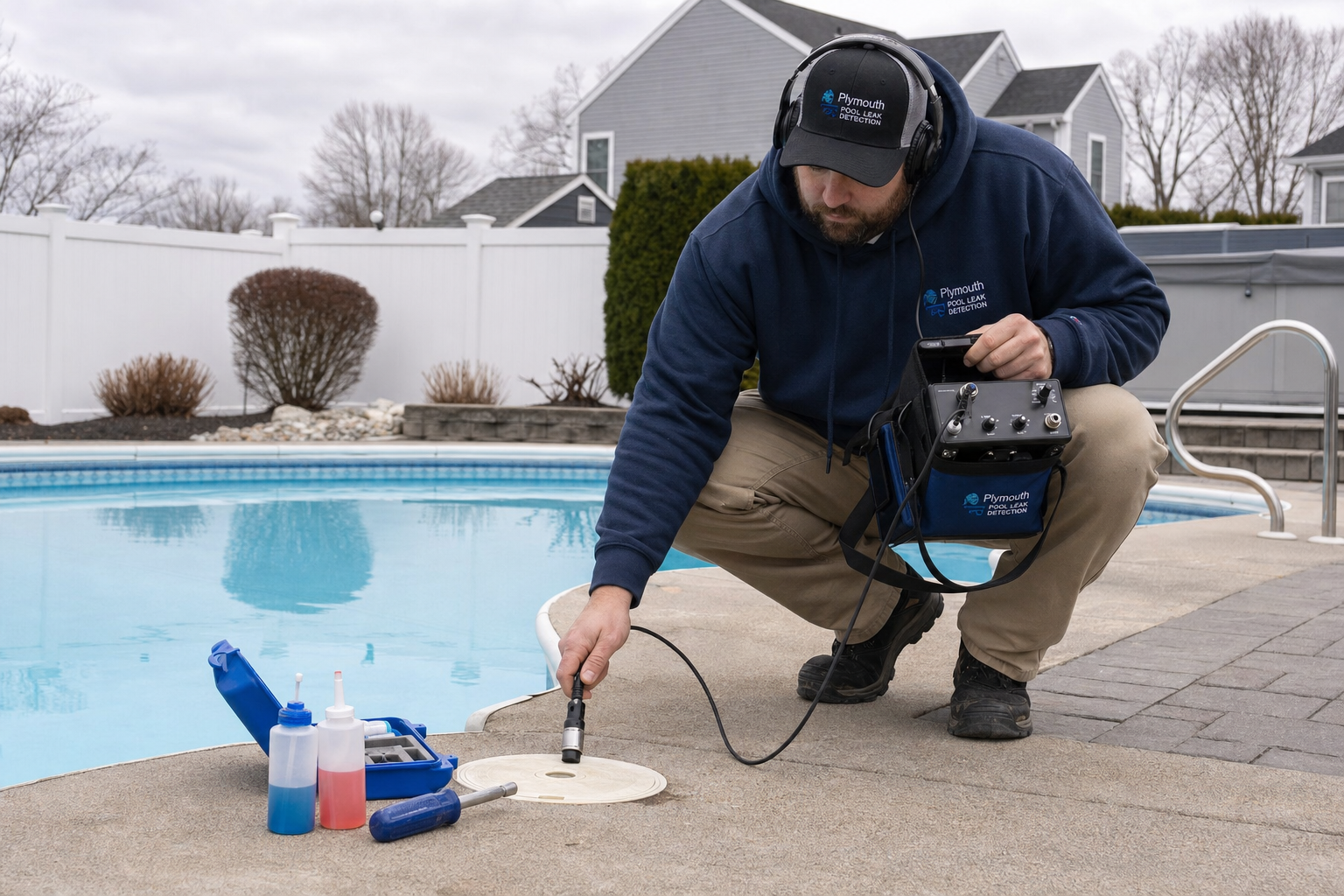
Pressure testing of plumbing lines. Each plumbing circuit is isolated and pressure-tested individually. A line that holds pressure is intact. A line that loses pressure has a breach somewhere in its run. This step can confirm or rule out underground plumbing as a leak source without any excavation — providing critical diagnostic clarity before committing to more expensive investigation or repair.
Dye testing. At suspect locations — the skimmer throat joint, return fittings, shell cracks, the light niche — non-staining dye is introduced near the suspected site. If a leak exists, the dye is drawn toward the gap and disappears into it, confirming the precise leak location. This visual confirmation is the most reliable method for locating fitting leaks and surface cracks.
Equipment pad inspection. The filter, pump, heater, and all valve bodies are checked while the pump is running for drips and fitting failures. Equipment pad leaks are common and often overlooked — a slowly weeping union or heater bypass fitting can lose significant water without obvious symptoms at the pool surface.
Written findings and repair estimate. Findings are documented in a written report: what was found, where the leak is, and the recommended repair approach with transparent pricing. No repair work begins without your authorization.
Common Pool Leak Types in Plymouth, MA
Plymouth’s geography creates specific conditions that influence which leak types are most prevalent:
Skimmer throat leaks. The most common pool leak type in any New England pool including Plymouth. The freeze-thaw cycling that acts on the joint between the plastic skimmer body and the concrete shell progressively opens a gap over 10 to 20 winters. This leak typically occurs only when the water level is at or above the skimmer throat — a helpful diagnostic clue.
Return fitting O-ring failures. Original threaded or push-in return fittings in older Plymouth pools have O-rings that age and harden over 25 to 40 years. A failing O-ring may lose only a small amount of water per day — easily confused with normal evaporation — but represents significant water and chemical loss over a season.
Underground plumbing failures. Plymouth’s variable soil conditions — from sandy outwash near the coast and ponds to heavier glacial till in elevated areas — create variable subsidence and movement conditions that can stress original PVC plumbing in older pools. Pressure testing isolates compromised lines without excavation in most cases, locating the problem before deciding on the least invasive repair approach.
Shell cracks. Structural cracks in the plaster and underlying gunite shell allow water to pass through the pool wall. Plymouth’s inland neighborhoods can experience harder overnight freezing than coastal Cape Cod, potentially accelerating crack development in pools that are closed inadequately.
Pool Leak Repair in Plymouth: Common Fixes
- Skimmer throat sealing: Hydraulic cement or structural epoxy applied to the gap between skimmer body and shell. Typically $200–$500.
- Return fitting replacement: O-ring or fitting replacement at wall fittings. $150–$400 per fitting.
- Light niche sealing or replacement: $300–$1,000 depending on scope.
- Shell crack injection: Epoxy injection for hairline to moderate cracks. $400–$2,000 depending on length and accessibility.
- Underground plumbing repair: Targeted excavation and pipe repair for confirmed underground failures. $1,200–$4,000+ depending on depth and line length.
Visit our Plymouth pool services page, browse our complete services catalog, or schedule a Plymouth leak detection appointment.
Contact Cape Cod Pool Repair
Cape Cod Pool Repair is your locally based pool repair and renovation specialist for Cape Cod and the South Shore. We provide free on-site estimates, perform all work with our own professional crew, and stand behind our work with clear warranty terms. We’re available at (508) 348-9990 Monday through Friday 8:00 AM to 5:00 PM and Saturday 9:00 AM to 2:00 PM, by email at info@capecodpoolrepair.com, and online at https://capecodpoolrepair.com/get-a-quote/. Our service area covers all of Cape Cod including Barnstable, Falmouth, Sandwich, Yarmouth, Dennis, Harwich, and Chatham, plus South Shore communities including Plymouth, Hingham, Quincy, and Brockton. Browse our complete pool services catalog or visit our Cape Cod and South Shore area pages for more information about what we do in your specific community.
Don’t wait for a small problem to become an expensive one. Cape Cod pools face some of the most demanding conditions of any pool market in the Northeast — freeze-thaw cycling, salt air, and compressed seasonal use intensity all take their toll on pool surfaces, plumbing, and equipment. Addressing developing issues early is the most cost-effective approach, and that starts with an honest professional assessment from a contractor who works in this environment every day. Call us at (508) 348-9990 to schedule yours.
Our Approach to Cape Cod and South Shore Pool Service
Cape Cod Pool Repair is headquartered at 100 Independence Drive, Hyannis, MA 02601 — centrally located on Cape Cod for efficient service throughout Barnstable County and the South Shore. We’re a locally owned and operated pool repair and renovation company, not a national franchise. All work is performed by our own professional crew using quality materials appropriate for New England’s demanding coastal environment.
Every project begins with a free on-site assessment. We visit the property, evaluate the pool’s specific condition, and provide a written proposal with transparent pricing and a clear scope of work before any commitment is required. We communicate honestly about what’s needed — including when we find that a repair is unnecessary or can be deferred — and we explain all material options so you can make an informed decision. Our service hours are Monday through Friday 8:00 AM to 5:00 PM and Saturday 9:00 AM to 2:00 PM. Reach us at (508) 348-9990, info@capecodpoolrepair.com, or online at https://capecodpoolrepair.com/get-a-quote/.
Pool leak detection is the first step in protecting your Plymouth pool from the costly secondary damage that water loss causes in our region’s variable soils and seasonal conditions. Browse our complete pool services catalog for the full range of services we provide, and visit our Cape Cod and South Shore area pages for location-specific service information. Whether you need a seasonal service, targeted repair, or comprehensive renovation, Cape Cod Pool Repair has the expertise and equipment to handle it correctly — in a coastal environment that demands contractors who understand it.
Frequently Asked Questions
How do I know if my Plymouth pool is leaking?
Use the bucket test: fill a bucket with pool water to the same level as the pool, mark both levels, and check after 24–48 hours. If the pool drops more than the bucket, a leak is likely. Normal Plymouth pool evaporation runs approximately 1/8 to 1/4 inch per day in summer. Loss exceeding 1/4 inch per day (more than 100 gallons per day for a standard pool) warrants professional investigation.
What does pool leak detection cost in Plymouth, MA?
Pool leak detection service in Plymouth typically costs $175–$425 for a comprehensive residential inspection including pressure testing of all plumbing lines, dye testing at suspect fittings, and a written diagnostic report. This covers the diagnostic — repairs are quoted separately. Cape Cod Pool Repair provides transparent pricing before the visit. Call (508) 348-9990.
What are the most common pool leak locations in Plymouth?
In Plymouth pools, the most common leak locations are the skimmer throat, return fitting O-ring failures, light niche seal failures, hairline cracks in the plaster shell, and underground plumbing failures in older pools. Plymouth’s variable soils — from sandy outwash to glacial till — create variable plumbing movement conditions that can stress joints in 25+ year old underground plumbing systems.
How long does pool leak detection take in Plymouth?
A standard residential pool leak detection appointment in Plymouth takes 2 to 4 hours including visual inspection, pressure testing, dye testing, and report documentation. Cape Cod Pool Repair travels from Hyannis to Plymouth via Route 3 in approximately 35 minutes. We schedule Plymouth service Monday through Friday 8:00 AM to 5:00 PM and Saturday 9:00 AM to 2:00 PM.
Does Cape Cod Pool Repair repair pool leaks after detection in Plymouth?
Yes — Cape Cod Pool Repair handles both detection and repair in Plymouth. After a leak is found and documented, we provide a written repair estimate before any repair work begins. Simple repairs are often completable on the same visit or within a few days. More complex repairs are scheduled appropriately. The same team that finds the leak fixes it — we don’t subcontract repair work.
Ready to schedule your pool leak detection?
Cape Cod Pool Repair serves Cape Cod and South Shore MA.
- 📞 (508) 348-9990
- 📧 info@capecodpoolrepair.com
- 📍 100 Independence Drive, Hyannis, MA 02601
- 🕐 Mon–Fri 8:00 AM – 5:00 PM | Sat 9:00 AM – 2:00 PM