A cracked pool deck is one of the most visible maintenance issues a Cape Cod pool owner faces—and one that can quickly escalate from cosmetic to structural if ignored. Pool deck crack repair in Hyannis, MA requires understanding both the cause of the cracking and the right repair material for the specific deck type. At Cape Cod Pool Repair, we repair concrete, stamped concrete, and paver decks throughout Hyannis, Barnstable, Yarmouth, Falmouth, Plymouth, and the greater South Shore.
Quick Answer: Why Pool Decks Crack on Cape Cod
- Freeze-thaw cycling – the primary driver; water infiltrates cracks, freezes, and expands, widening cracks each winter
- Soil settlement – sandy Cape Cod soils shift under load, creating differential movement in the slab
- Improper joint placement – expansion/control joints missing or too widely spaced at original installation
- Tree root intrusion – roots from nearby oaks or pitch pines lift sections of deck
- Overloading – heavy equipment, vehicles, or storage on the deck exceeding its design load
Types of Pool Deck Cracks and What They Mean
Hairline Cracks
Hairline cracks (less than 1/16 inch wide) are primarily cosmetic and form as concrete cures and experiences its initial thermal cycling. On Cape Cod, virtually every unreinforced concrete pool deck more than 3–5 years old will show some hairline cracking. These cracks become a problem when they allow water infiltration that accelerates freeze-thaw damage or when they connect and widen.
Settlement Cracks
Settlement cracks appear when underlying soil compresses unevenly, causing sections of the slab to drop at different rates. These cracks often run diagonally and may be accompanied by an edge that is higher than the other—a condition called differential settlement or “trip edge.” Trip edges are a safety hazard and require prompt repair. In Hyannis and the surrounding area, where glacial till and fill soils are common, settlement cracking is the leading cause of significant pool deck damage.
Expansion Joint Failures
Properly installed pool decks include expansion joints—intentional gaps filled with flexible sealant—at regular intervals and wherever the deck meets the pool coping, the house foundation, or other structures. When this sealant hardens and cracks after 5–10 years, the joint no longer accommodates movement and forces cracks to develop elsewhere in the slab. Expansion joint resealing is a proactive maintenance task that prevents much larger repairs.
Spalling
Spalling is the flaking or chipping of the concrete surface layer, often accompanied by a pitted, rough texture. It commonly results from freeze-thaw damage to inadequately air-entrained concrete or from salt damage on decks near the ocean. Spalled surfaces are uncomfortable underfoot, difficult to clean, and accelerate further deterioration if not resurfaced.
Pool Deck Crack Repair Methods
Polyurethane or Epoxy Crack Injection
For structural cracks where the two sides are at the same level (no differential movement), low-viscosity polyurethane or epoxy injection fills the crack completely and restores tensile strength. The crack is cleaned, surface preparation is applied, and the injected material cures to create a bond stronger than the surrounding concrete. This method is ideal for cracks up to 1/2 inch wide in sound, stable deck sections.
Flexible Sealant for Moving Cracks
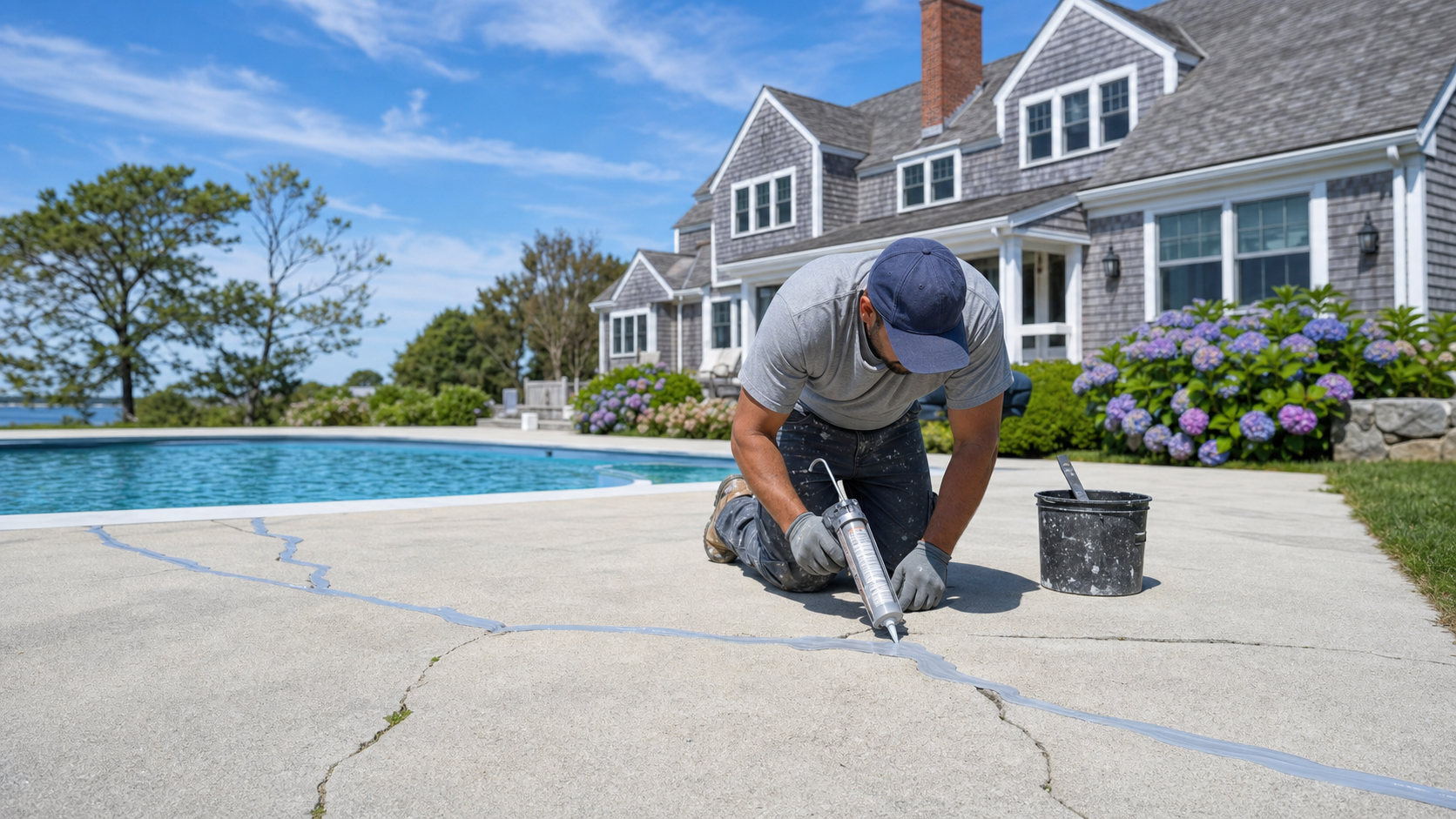
Cracks that cross expansion joint locations or that show signs of seasonal movement (widening in winter, narrowing in summer) should not be repaired with rigid epoxy. Instead, a polyurethane or polysulfide flexible sealant accommodates movement without re-cracking. The crack is routed to a uniform width and depth, filled with backer rod (a foam cord that controls sealant depth), and sealed with the flexible compound.
Concrete Overlay for Spalled Decks
Decks with widespread spalling or a network of surface cracks can be resurfaced with a polymer-modified concrete overlay. Applied in a 1/4–1/2 inch layer, the overlay provides a fresh, smooth surface that bonds to the existing concrete. Color and texture can be customized—including broom finish, exposed aggregate, or stamped patterns to match existing sections. For Hyannis properties where aesthetics matter, we offer overlays that blend seamlessly with the original deck style.
Mudjacking or Foam Jacking for Settled Sections
When a section of pool deck has settled significantly below grade, raising it is more effective than pouring a new slab overlay. Mudjacking injects a sand-cement slurry beneath the slab through small drilled holes, lifting it back to original grade. Polyurethane foam jacking (also called slab lifting) is a newer, lighter alternative that uses expanding foam to raise settled slabs. Both methods correct trip edges and restore proper drainage slope away from the pool.
Pool Deck Crack Repair Costs in Hyannis
- Hairline crack sealing (per linear foot): $4–$8/LF
- Structural crack injection: $150–$400 per crack
- Expansion joint resealing (full pool): $300–$700
- Mudjacking/foam jacking per slab section: $500–$1,500
- Full concrete overlay (per sq ft): $6–$14/sq ft
When to Repair vs. Replace Your Pool Deck
Repair makes sense when: the deck is structurally sound in most areas, cracks are localized, and the slab is less than 20–25 years old. Replacement is more appropriate when: cracking is widespread throughout the slab, the concrete is heavily spalled and deteriorated, settlement is severe and ongoing, or when the homeowner wants to change deck material (e.g., replacing concrete with pavers).
A partial slab replacement is also an option for sections with severe damage adjacent to sound concrete—allowing targeted renewal without the cost of a full replacement.
AEO Quick Recap: Pool Deck Crack FAQs
- Is a cracked pool deck a safety hazard? Yes, if cracks create trip edges (differential height between slab sections greater than 1/4 inch). These pose a fall risk particularly for children running around the pool. Any vertical displacement should be repaired promptly.
- Can pool deck cracks be repaired in winter? Concrete crack repair requires temperatures above 40°F for proper curing. In Massachusetts, this limits outdoor crack repair to approximately April through October. Planning repairs in spring, before the swim season begins, avoids water infiltration over another winter.
- Do paver pool decks crack? Individual pavers can crack or chip, but paver decks are generally more resistant to cracking than poured concrete because the joints between pavers act as built-in expansion accommodation. When pavers settle unevenly, individual units can be lifted, base material adjusted, and pavers reinstalled without touching surrounding sections.
FAQ: Pool Deck Crack Repair in Hyannis and Cape Cod
How do I know if my pool deck crack is serious?
A crack is serious if it is wider than 1/4 inch, if one side is higher than the other (creating a trip edge), if the crack is growing in length or width, if water pools in the crack, or if vegetation is growing through it. Any crack that is deteriorating between seasons warrants professional evaluation before the next winter.
Can I seal pool deck cracks myself?
Hairline cracks and expansion joint resealing are reasonable DIY projects for homeowners comfortable with caulk guns and concrete preparation. Purchase a polyurethane concrete sealant rated for pool deck use, thoroughly clean and dry the crack, and apply sealant. However, cracks associated with settlement, trip edges, or water infiltration require professional assessment to address the underlying cause.
How long does pool deck crack repair take?
Crack injection repairs cure within 4–24 hours depending on material. Full concrete overlay projects require 3–5 days including surface preparation, application, and cure time before foot traffic is permitted. Mudjacking is typically complete within a few hours and accessible the same day.
What type of sealant should I use for pool deck expansion joints near Hyannis?
Two-part polyurethane sealants or polysulfide sealants are most appropriate for pool deck expansion joints in Massachusetts’ climate. They remain flexible through temperature extremes from -30°F to +180°F and are resistant to pool chemicals and UV degradation. Single-component silicone sealants are not recommended for pool deck joints as they do not bond well to concrete.
Does Cape Cod Pool Repair fix pool decks in Barnstable and Plymouth?
Yes. We provide pool deck crack repair, expansion joint resealing, and resurfacing throughout Hyannis, Barnstable, Yarmouth, Falmouth, Plymouth, and the full Cape Cod and South Shore area. Contact us to schedule a deck assessment, or get a free quote online.
Fix Your Hyannis Pool Deck This Spring
A well-maintained pool deck is safe, attractive, and protects your pool shell from water infiltration. If your Hyannis pool deck is showing cracks, settlement, or spalling, don’t wait until a small problem becomes a large one. Cape Cod Pool Repair provides expert pool deck repair alongside our comprehensive pool maintenance and renovation services. Schedule your consultation today and go into this summer with a deck you can count on.
Pool Deck Materials and Their Crack-Resistance in Cape Cod’s Climate
Not all pool deck materials perform equally in Cape Cod’s demanding climate. If you’re planning a pool deck repair or replacement, understanding the crack resistance and maintenance requirements of different materials helps you make a choice that minimizes future repair needs.
Poured Concrete
Poured concrete is the most common pool deck material in Hyannis and the wider Barnstable area. It is durable, cost-effective to install, and versatile in finish options (broom, exposed aggregate, stamped). Its primary weakness is susceptibility to cracking from freeze-thaw stress and soil movement. The key quality indicators for a crack-resistant concrete deck are: adequate air entrainment (5–7% air content for Massachusetts climate), proper control joint placement (every 8–10 feet in each direction), a minimum 4-inch slab thickness, and a steel or fiber reinforcement mesh. Existing concrete decks without these features will always be crack-prone, and the best long-term solution may be replacement rather than perpetual repair.
Pavers
Concrete or natural stone pavers handle Cape Cod’s freeze-thaw cycles better than poured concrete because the joints between individual units accommodate movement that would crack a continuous slab. When properly installed over a compacted gravel base with polymeric sand joints, a paver pool deck can last 25–40 years with minimal maintenance beyond occasional joint sand replenishment. Individual cracked or settled pavers can be replaced without disturbing the surrounding installation. The upfront cost is higher than poured concrete but the lifetime maintenance cost is typically lower.
Travertine and Natural Stone
Travertine and other natural stone decking materials are increasingly popular on higher-end Hyannis and Barnstable pool projects because of their natural beauty and cool-to-the-touch surface temperature. Natural stone is porous and requires sealing, and some types can crack in severe freeze-thaw cycles if the base is not properly designed. However, properly sealed and installed natural stone deck sections can outlast the pool itself when well-maintained. Individual cracked units can be replaced.
Composite and PVC Decking
Composite or PVC board decking is occasionally used around pools in elevated deck configurations or for pool surrounds on coastal properties where ground-level installation is impractical. These materials do not crack from freeze-thaw cycling and are immune to most chemical exposure. However, they are typically more expensive than concrete alternatives and are primarily used for above-ground pool surrounds or sections of deck adjacent to spa structures.
Deck Safety and Code Compliance in Hyannis
Pool deck safety is regulated by local building codes and the Massachusetts State Building Code. In Hyannis and throughout Barnstable County, pool decks must provide a non-slip surface, maintain a minimum width of 4 feet for walkways around the pool perimeter, and accommodate proper drainage away from the pool and the house foundation. Significant alterations to pool deck configuration—including adding new sections, changing drainage, or altering the pool barrier—may require permits from the Town of Barnstable Building Department.
Our crack repair work focuses on restoring both the structural integrity and the safety of your pool deck. We correct trip edges that create fall hazards, restore proper drainage slopes that have shifted with settlement, and ensure that the repaired surface meets applicable safety standards. Contact Cape Cod Pool Repair to schedule a pool deck safety assessment, or request a free estimate for crack repair or resurfacing through our online quote page. We serve Hyannis, Barnstable, Yarmouth, Falmouth, Plymouth, and all of the South Shore.