
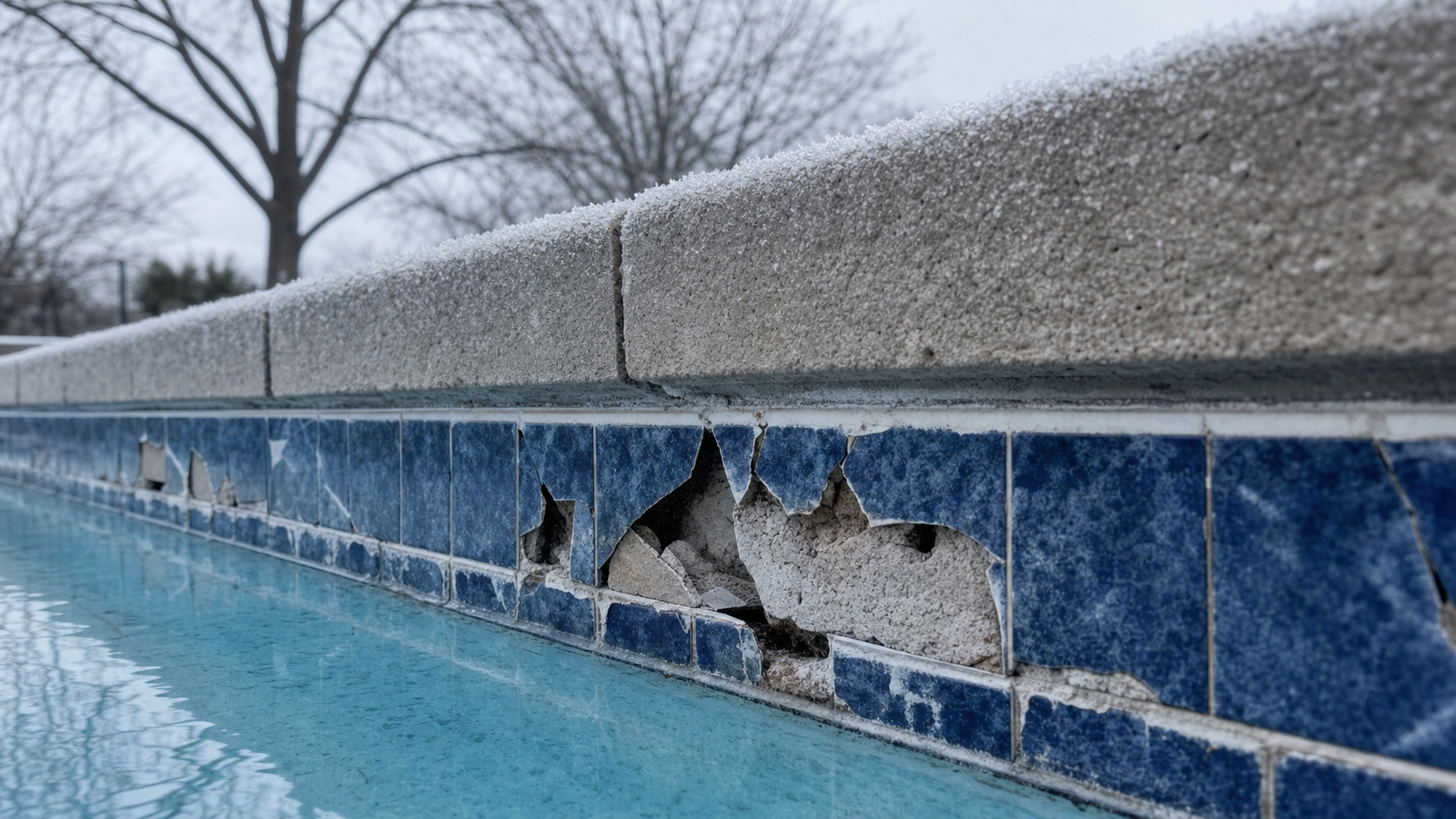
Freeze-thaw damage is the leading cause of pool tile and coping failure on Cape Cod — and it operates with a patience that makes it easy to underestimate until it has already done significant damage. The mechanism is physically simple but relentlessly effective: water trapped in any crack, grout joint, or gap expands as it freezes, then contracts as it thaws. With 30 to 70 such cycles per Cape Cod winter, repeated for 10 to 20 years, the cumulative effect on pool tile and coping installations is dramatic. This guide explains how freeze-thaw cycling damages tile and coping in Cape Cod pools, how to recognize when damage has become significant, and what repair options are available.
The Physics of Freeze-Thaw Damage in Pool Tile and Coping
Understanding why freeze-thaw damage occurs helps explain why maintaining tile and grout integrity matters so much in Cape Cod’s climate — and why even seemingly small grout failures can lead to significant tile loss within a few winters.
Water expands by approximately 9% when it freezes. In a grout joint, a hairline crack in mortar, or a gap between a tile and the pool shell, this expansion can generate pressures approaching 50,000 pounds per square inch in a fully confined space. This force acts outward from the point of freezing, pushing the surrounding material apart — tile, grout, mortar, coping stone.
On the first freeze event of the season, the force may not be enough to visibly move material. But it opens the gap slightly. The next thaw draws in more water. The next freeze expands it in a slightly larger gap. By the 30th or 40th cycle — a number that a Cape Cod pool can reach in a single winter — what began as an invisible hairline has become a visible crack. By the 60th or 70th, the mortar bond behind an adjacent tile has broken and the tile is ready to detach.
This compounding mechanism explains why tile failure in Cape Cod pools often seems sudden. The visible failure is sudden. The damage accumulation has been building through dozens of freeze-thaw cycles until the final bond failure.
Most Vulnerable Pool Tile and Coping Locations in Cape Cod Pools
Freeze-thaw water damage concentrates at specific locations in any pool installation. Understanding these vulnerable spots helps target your inspection efforts at opening and closing:
The waterline tile band. The entire waterline band is vulnerable because it sits exactly at the water surface — where temperature swings are greatest and where any water remaining at the tile level when temperatures drop creates direct freeze contact. But within the waterline band, corners and transitions are the most vulnerable points: inside corners concentrate thermal stress, and the ends of tile runs where the installation terminates are common starting points for mortar failure.
The tile-to-coping joint. Where the top row of waterline tile meets the underside of the coping overhang, a joint exists that is exposed to moisture infiltration from above (rain, pool splash-out) and below (pool water, condensation). If this joint is not watertight — filled with flexible caulk rather than rigid mortar — it becomes a water entry point that directs infiltration directly behind the waterline tile installation.
The coping-to-deck expansion joint. This critical joint between the pool coping and the surrounding deck is the most commonly compromised joint in the entire pool perimeter. It should be filled with polyurethane or silicone flexible caulk — not rigid mortar — to accommodate thermal movement. When filled with rigid mortar (a common installer shortcut), it cracks in the first or second winter season, opening a direct channel for water to reach the coping underside and bond beam.
Coping mortar joints. The mortar bed beneath coping stones and the mortar joints between coping units both absorb moisture and are subject to freeze-thaw expansion. Older Portland cement mortars — without the polymer modification that improves freeze-thaw resistance in modern products — are most vulnerable. Once mortar joints open, even slightly, the infiltration cycle accelerates.
Cape Cod’s Climate Pattern: Why Cycling Frequency Matters
Not all freeze-thaw climates are equal. Cape Cod’s specific climate pattern creates conditions that are uniquely damaging to pool tile and coping:
High cycle frequency, not depth, is the key damage driver. A pool in northern Maine may experience sustained deep freezing where the ground and pool area freeze solid for months. Cape Cod’s ocean moderation prevents this — the region rarely experiences sustained temperatures below 15°F. But Cape Cod experiences the above-and-below cycling through 32°F many more times per season than colder but more stable northern climates. Research on concrete and mortar degradation consistently shows that higher cycle frequency produces more cumulative damage than lower frequency at equivalent temperature depths.
Late-season surprise freezes. Cape Cod winters are irregular. Mild January weeks followed by hard February freezes. March thaws followed by late March hard frosts. This irregular pattern means that pool covers that have shifted, water that has pooled at the waterline level, or covers whose pumps have failed can introduce water to the pool edge at unexpected times. The last hard freeze of the season — sometimes in early April — can cause tile damage just when pool owners are starting to think about opening.
Salt air interaction. Cape Cod’s coastal salt air degrades grout and mortar faster than inland locations. Standard Portland cement grout absorbs moisture — with repeated salt-laden wetting and drying, the cement binder erodes faster. This means that the grout joints protecting against freeze-thaw water infiltration degrade faster here than in non-coastal settings, creating more entry points earlier in the installation’s life.
Inspecting for Freeze-Thaw Damage at Spring Opening
Spring pool opening is the ideal time to assess freeze-thaw tile and coping damage. Here is what to check:
- Walk the waterline as the pool fills. Press on every tile section. Tiles that shift, feel loose, or sound hollow are no longer bonded.
- Look along the waterline band at pool-edge level. Open grout joints, cracked grout lines, and gaps between tile sections are visible in this viewing angle.
- Check the coping-to-deck joint. This expansion joint should show flexible caulk — not rigid mortar. If it shows cracking, missing filler, or gap opening, it needs re-caulking before water infiltrates again next winter.
- Look for efflorescence. White calcium carbonate deposits seeping from behind tiles at grout joints indicate active water infiltration behind the installation that has been occurring for at least one season.
- Press on coping stones. Any coping stone that moves or shifts when pressed has a compromised mortar bed and should be releveled and repointed.
Cape Cod Pool Repair provides post-winter tile and coping inspections throughout Cape Cod and the South Shore. Visit our Cape Cod pool services page, browse our complete services catalog, or request a free tile and coping inspection. Catching this damage at opening is significantly less expensive than mid-season emergency service.
Contact Cape Cod Pool Repair
Cape Cod Pool Repair is your locally based pool repair and renovation specialist for Cape Cod and the South Shore. We provide free on-site estimates, perform all work with our own professional crew, and stand behind our work with clear warranty terms. We’re available at (508) 348-9990 Monday through Friday 8:00 AM to 5:00 PM and Saturday 9:00 AM to 2:00 PM, by email at info@capecodpoolrepair.com, and online at https://capecodpoolrepair.com/get-a-quote/. Our service area covers all of Cape Cod including Barnstable, Falmouth, Sandwich, Yarmouth, Dennis, Harwich, and Chatham, plus South Shore communities including Plymouth, Hingham, Quincy, and Brockton. Browse our complete pool services catalog or visit our Cape Cod and South Shore area pages for more information about what we do in your specific community.
Don’t wait for a small problem to become an expensive one. Cape Cod pools face some of the most demanding conditions of any pool market in the Northeast — freeze-thaw cycling, salt air, and compressed seasonal use intensity all take their toll on pool surfaces, plumbing, and equipment. Addressing developing issues early is the most cost-effective approach, and that starts with an honest professional assessment from a contractor who works in this environment every day. Call us at (508) 348-9990 to schedule yours.
Frequently Asked Questions
How many freeze-thaw cycles does Cape Cod experience each winter?
Cape Cod typically experiences 30 to 70 individual freeze-thaw cycles per winter season — days where temperature crosses the 32°F threshold in both directions. The coastal moderation from the surrounding ocean means Cape Cod rarely sustains consecutive weeks of deep cold, instead cycling repeatedly above and below freezing from November through March. This cycling pattern is more damaging to pool tile and coping mortar than sustained cold, because each cycle physically opens and closes water-filled gaps.
Can proper pool closing prevent freeze-thaw tile damage?
Yes — proper pool closing is the single most effective preventive measure. The key is ensuring the water level at closing is lowered at least 6 inches below the lowest waterline tile, so no water contacts the tile-to-shell joint during winter. Additionally, inspecting tile grout and coping joints at closing for any openings allows pre-winter repair scheduling. Cape Cod Pool Repair includes a tile and coping inspection with every professional pool closing service.
What is the most common tile repair after a Cape Cod winter?
The most common post-winter tile repair is loose or detached waterline tiles — typically 1 to 3 per linear foot on pools with older or deteriorated grout. The second most common is cracked grout joints. Full tile detachment involving multiple adjacent tiles occurs when the adhesive mortar has completely failed over a section, usually indicating water has been infiltrating behind the tile for multiple seasons before the final failure event.
Should tile and coping repairs be combined?
Yes — combining tile and coping repairs in one project is strongly recommended when both need attention. Both require the pool to be partially or fully drained, and mobilization and drain-down costs are shared. Doing them in separate projects means paying those costs twice. Scheduling combined repairs at spring opening (when the pool is already partially drained for inspection) is the most cost-efficient timing.
How much does post-winter tile and coping repair cost on Cape Cod?
Post-winter tile and coping repair costs vary based on damage extent. Minor repairs — a few loose tiles and repointing of grout joints — typically run $400–$1,200. More extensive damage involving multiple tile sections plus coping repointing runs $1,500–$4,000. Full tile replacement combined with coping replacement is a $4,000–$10,000 project for a standard pool. Cape Cod Pool Repair provides free estimates for all post-winter tile and coping repairs.
Ready to schedule your tile and coping repair?
Cape Cod Pool Repair serves Cape Cod and South Shore MA.
- 📞 (508) 348-9990
- 📧 info@capecodpoolrepair.com
- 📍 100 Independence Drive, Hyannis, MA 02601
- 🕐 Mon–Fri 8:00 AM – 5:00 PM | Sat 9:00 AM – 2:00 PM