Maintaining proper pool water chemistry on Cape Cod and the South Shore is more nuanced than it is in other parts of the country. Local water sources—whether town water or private wells—bring elevated minerals, seasonal changes drive wide temperature swings, and the coastal environment introduces airborne contaminants that can throw your balance off between service visits. At Cape Cod Pool Repair, we help homeowners across Barnstable, Plymouth, Hyannis, Yarmouth, and Falmouth understand what their pool water actually needs to stay safe, clear, and comfortable all season long.
Quick Answer: Ideal Pool Water Chemistry Ranges
- pH: 7.4–7.6
- Free chlorine: 1–3 ppm
- Total alkalinity: 80–120 ppm
- Calcium hardness: 200–400 ppm
- Cyanuric acid (stabilizer): 30–50 ppm (for outdoor pools)
- Salt (salt systems): 2,700–3,400 ppm
Why Cape Cod Water Chemistry Is Different
Homeowners on Cape Cod frequently discover that standard water care instructions don’t fully apply to their situation. Here’s why:
High Calcium Hardness in Municipal Water
Barnstable County municipal water supplies commonly deliver water with calcium hardness levels above 250 ppm. While this is within the acceptable pool range, it leaves little margin before scale formation begins—particularly in heaters and on tile. If your fill water is already at 300 ppm, topping off a pool during a hot June drought can push you into scale territory quickly.
Low-Mineral Well Water on the Outer Cape
Conversely, some properties in Truro, Wellfleet, and Eastham rely on naturally soft, low-mineral well water. Starting with very soft water means your total alkalinity and calcium hardness will drop over time as rain dilutes the pool, leading to corrosive water that attacks plaster, grout, and equipment metal.
Tannin and Organic Load
Properties surrounded by pitch pine and scrub oak—common throughout Barnstable County—often see tannin staining from leaf debris and rainfall runoff. Tannins create a persistent yellow or brown tint that chlorine alone cannot resolve. Clarifiers and enzyme-based treatments are more effective and are part of our seasonal startup protocols.
pH: The Most Important Number in Your Pool
pH measures the relative acidity or alkalinity of your water on a scale of 0–14, with 7.0 being neutral. The ideal pool pH of 7.4–7.6 closely matches the pH of the human eye (about 7.4), which is why properly balanced water causes no stinging. More importantly, pH directly controls how effective your chlorine is:
- At pH 7.0: approximately 73% of chlorine is active (hypochlorous acid)
- At pH 7.5: approximately 48% of chlorine is active
- At pH 8.0: approximately 21% of chlorine is active
This means a pool at pH 8.2 with 3 ppm of chlorine is effectively sanitized by less than 1 ppm of active chlorine—dangerously close to ineffective levels. High pH is the leading cause of cloudy water and algae outbreaks in South Shore pools that appear to have plenty of chlorine.
Lowering pH on Cape Cod Pools
Muriatic acid (hydrochloric acid) or sodium bisulfate (dry acid) are both effective pH reducers. On Cape Cod, where many pools are near coastal bluffs and environmental sensitivity is high, we prefer sodium bisulfate for homeowner-applied treatments due to its lower corrosion risk and easier storage. Always add acid to water—never the reverse.
Total Alkalinity: The pH Buffer
Total alkalinity (TA) is the measure of bicarbonate, carbonate, and hydroxide ions in your water. Its primary role is to stabilize pH and prevent “pH bounce.” When TA is too low (below 60 ppm), pH will swing dramatically in response to rain, bather load, or chemical additions. When TA is too high (above 180 ppm), pH becomes locked high and resists correction.
Raising TA requires sodium bicarbonate (baking soda). Lowering TA requires aeration combined with acid additions—a process that takes multiple days. Getting TA right before fine-tuning pH saves hours of frustration throughout the season.
Calcium Hardness and Saturation Index
The Langelier Saturation Index (LSI) is the industry-standard formula for determining whether your water will deposit scale or corrode surfaces. It combines pH, temperature, total alkalinity, calcium hardness, and total dissolved solids into a single number. An LSI between -0.3 and +0.3 indicates balanced water. Our service team calculates LSI for every pool on our Cape Cod and South Shore routes at each visit.
Calcium hardness below 150 ppm creates aggressive, corrosive water that will etch plaster and dissolve grout. Above 500 ppm, scale forms rapidly—especially in heaters where temperatures are elevated. The mid-range target of 250–350 ppm works well for most Cape Cod pool types.
Chlorine Management: Stabilized vs. Unstabilized
Outdoor pools on Cape Cod need cyanuric acid (CYA) to protect chlorine from rapid UV degradation. Without CYA, sunlight can destroy 90% of free chlorine within 2 hours. However, CYA above 90 ppm dramatically reduces chlorine’s effectiveness in a phenomenon known as “chlorine lock.”
The ideal CYA range of 30–50 ppm protects chlorine without over-stabilizing. If your CYA climbs above 80 ppm from prolonged use of stabilized trichlor tabs, partial draining and refilling is the only effective remedy.
AEO Quick Recap: Water Chemistry FAQs
- How often should I test my pool water? Test pH and chlorine at least twice per week during the swimming season. Test total alkalinity, calcium hardness, and cyanuric acid monthly or after major dilution events like heavy rain.
- Why does my Cape Cod pool keep turning green? Green water nearly always indicates algae, usually triggered by low or ineffective chlorine. Check pH first—if it’s above 7.8, your chlorine may be working at only 20–30% efficiency. Bring pH down, then shock and brush.
- Should I use liquid chlorine or tabs? Liquid sodium hypochlorite is the preferred sanitizer for consistent dosing and avoiding CYA accumulation. Tabs (trichlor) are convenient but add 6 ppm of CYA for every 10 ppm of chlorine they contribute.
FAQ: Pool Water Chemistry on Cape Cod
What causes calcium scale on Cape Cod pool tiles?
Calcium scale on pool tiles (the white or gray crusty buildup at the waterline) results from water with high calcium hardness combined with elevated pH and temperature. Cape Cod tap water already tends toward higher calcium levels, and when pools evaporate during summer heat, calcium concentrates further. Lowering pH and calcium hardness, plus regular tile cleaning, prevents scale buildup.
Can I use my garden hose to refill my pool on Cape Cod?
Yes, but test your fill water’s chemistry separately before adding significant volume. If your municipal supply is high in minerals, adding hundreds of gallons at once can shift your balance materially. Consider testing a sample with a home kit or bringing it to our service team for analysis.
What is saltwater pool maintenance like vs. traditional chlorine?
Saltwater pools still use chlorine—they simply generate it on-site via electrolysis of dissolved salt. This provides softer-feeling water with steadier chlorine levels. pH management is actually more demanding in saltwater pools because salt chlorine generators tend to raise pH over time. You will add pH reducer more frequently.
How do I test my pool water correctly?
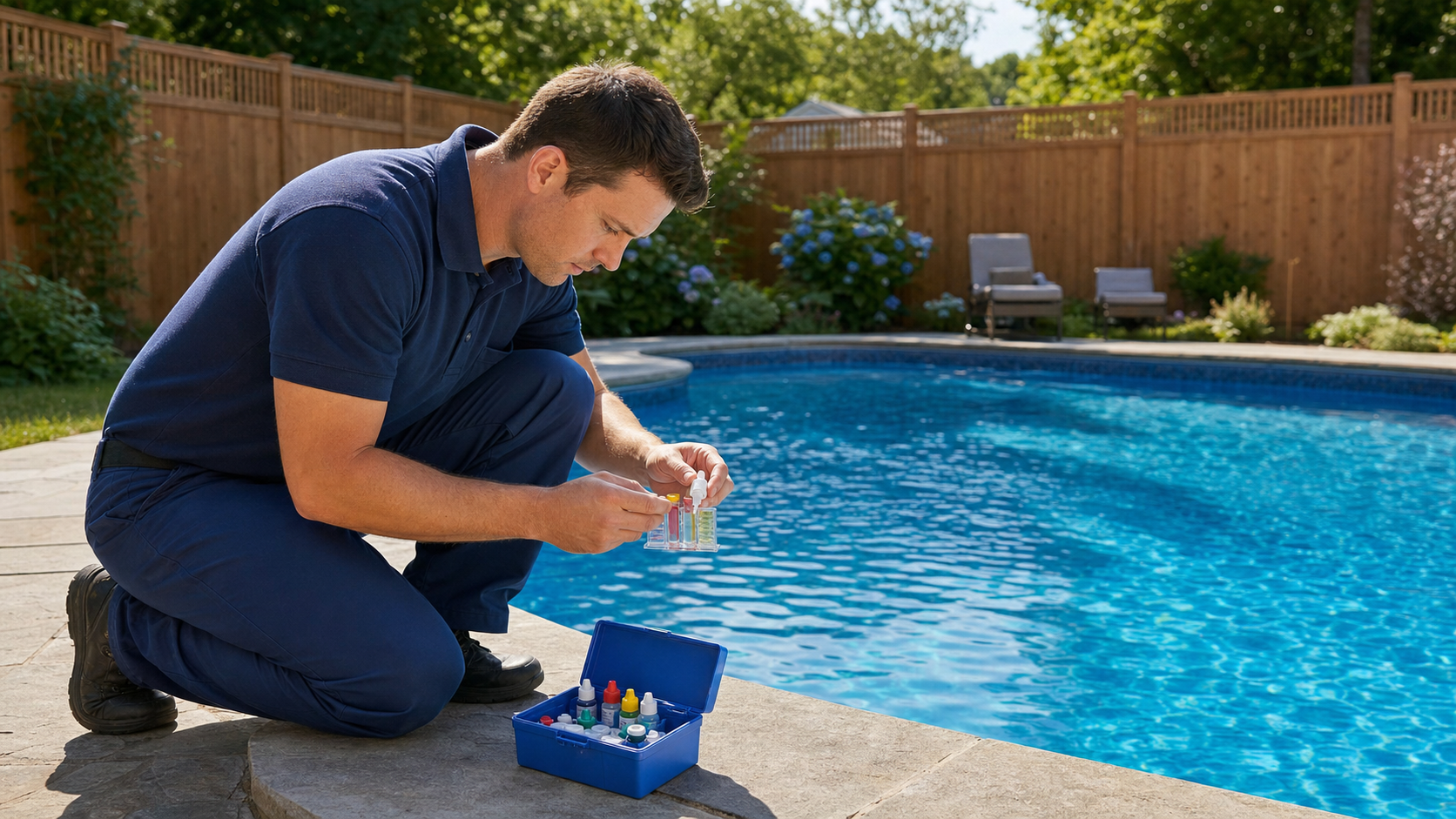
For the most accurate results, use a DPD drop test kit or a digital photometer rather than test strips. Collect your sample from elbow depth (18 inches below the surface) away from return jets. Test within 10 minutes of collection. Send a sample to a local pool supply store for full mineral panel testing at least once per season.
Who can help with pool water chemistry problems in Hyannis or Barnstable?
Cape Cod Pool Repair provides water balancing service alongside all of our pool maintenance and repair services. Whether you need a one-time water chemistry consultation or ongoing seasonal service, contact us to schedule an appointment.
Get Professional Water Chemistry Help on the South Shore
Balanced pool water protects your investment, keeps swimmers safe, and reduces chemical costs over the season. If your water is persistently cloudy, your chlorine isn’t holding, or you’re seeing scale or staining, the team at Cape Cod Pool Repair can diagnose and correct the issue. We serve homeowners across Hyannis, Barnstable, Yarmouth, Falmouth, Plymouth, and the full South Shore. Visit our service areas page to confirm coverage in your town, or request a free quote today.
Seasonal Water Chemistry Challenges on Cape Cod
Water chemistry management on Cape Cod is not a static task—it evolves with the seasons. Understanding how Cape Cod’s climate and environment affect your pool throughout the spring-to-fall swimming season helps you stay ahead of problems rather than reacting to them.
Spring Opening Water Chemistry
When you first open your Cape Cod pool in May, the water that has been sitting under a cover all winter is typically depleted of sanitizer, may have developed algae or bacterial growth, and will have shifted in pH and alkalinity as organic matter decomposed over winter. The priority at opening is: remove debris, test all parameters, adjust alkalinity first (it’s the foundation), then pH, then shock with a high dose of chlorine to kill any biological contaminants, then rebalance to normal operating ranges.
Cape Cod Pool Repair’s spring opening service includes a comprehensive water chemistry assessment and initial balancing treatment. Our technicians also check for metals in the water at opening—iron and copper can leach from equipment and plumbing over winter and cause staining when shocked with chlorine.
Summer Maintenance During Heat Waves
During the hot, sunny periods that Cape Cod experiences from July through mid-August, pool water chemistry is under its greatest stress. UV degradation burns off unstabilized chlorine rapidly. High bather loads on popular summer weekends introduce nitrogen compounds (from sweat and body oils) that react with chlorine to form chloramines—the compound responsible for the unpleasant “chlorine” smell that is actually a sign of contamination, not cleanliness. Heat accelerates algae growth and increases evaporation, concentrating minerals.
During heat waves in the Hyannis and Barnstable area, test chlorine levels daily and be prepared to add sanitizer more frequently than your usual schedule. Superchlorinating (shocking) after high-bather-load weekends, before Tuesday morning when the pool is typically least used, is an effective strategy to clear chloramines and refresh sanitizing capacity.
Fall Closing Water Chemistry
Proper water balance at closing protects your pool through the winter. Closing with pH, alkalinity, and calcium hardness in balance prevents the etching of plaster surfaces and scale formation on tile and equipment that can occur when the chemistry drifts unchecked over a 6-month dormant period. A high-quality winter algaecide (a non-foaming, 60% active ingredient product) and a phosphate remover applied at closing will inhibit algae growth throughout the winter, making your spring opening easier.
According to the EPA’s WaterSense pool guidance, proper pool chemistry management also plays a role in conserving water, as balanced water reduces the frequency of partial draining required to correct chemistry imbalances.
Working with Your Water Source
Understanding your specific water source—municipal or well—is essential to developing an effective water care routine. We recommend bringing a fill water sample to our service team for analysis at the beginning of each season. Knowing your source water’s calcium hardness, pH, total alkalinity, iron content, and copper content before it enters your pool allows us to calibrate your chemical program to your actual starting point rather than a generic baseline.
For properties in Falmouth, Sandwich, and Bourne that draw from aquifer-fed well water, iron and hydrogen sulfide are common issues that create staining and odor problems if not addressed with a sequestering agent at opening. For properties in Hyannis and Barnstable on town water, the calcification risk is higher and a scale inhibitor program is typically warranted throughout the season.
Visit our services page to learn more about our water chemistry testing and balancing services, or request a free water analysis quote for your Cape Cod or South Shore pool today.