When your pool pump starts making a grinding noise, your filter loses pressure, or your heater fails to ignite on the first warm weekend of the season, you need pool equipment repair on Cape Cod that’s fast, knowledgeable, and backed by local experience. At Cape Cod Pool Repair, our technicians service pool systems across Barnstable County and the South Shore—from Hyannis and Yarmouth to Falmouth, Plymouth, and everywhere in between.
This guide walks you through the most common equipment failures, what repairs typically cost in Massachusetts, and how to decide when to call a professional versus attempting a DIY fix.
Quick Answer: Most Common Pool Equipment Repairs
- Pool pump failure – motor burnout, cavitation, seal leaks ($150–$800)
- Filter issues – cracked laterals, broken multiport valves, DE grid tears ($80–$350)
- Heater problems – ignition failure, heat exchanger scale, thermostat faults ($200–$600)
- Salt cell replacement – chlorine generator cleaning or full cell swap ($100–$500)
- Automation system faults – board failure, sensor errors, wiring issues ($150–$700)
Pool Pump Repair: The Heart of Your System
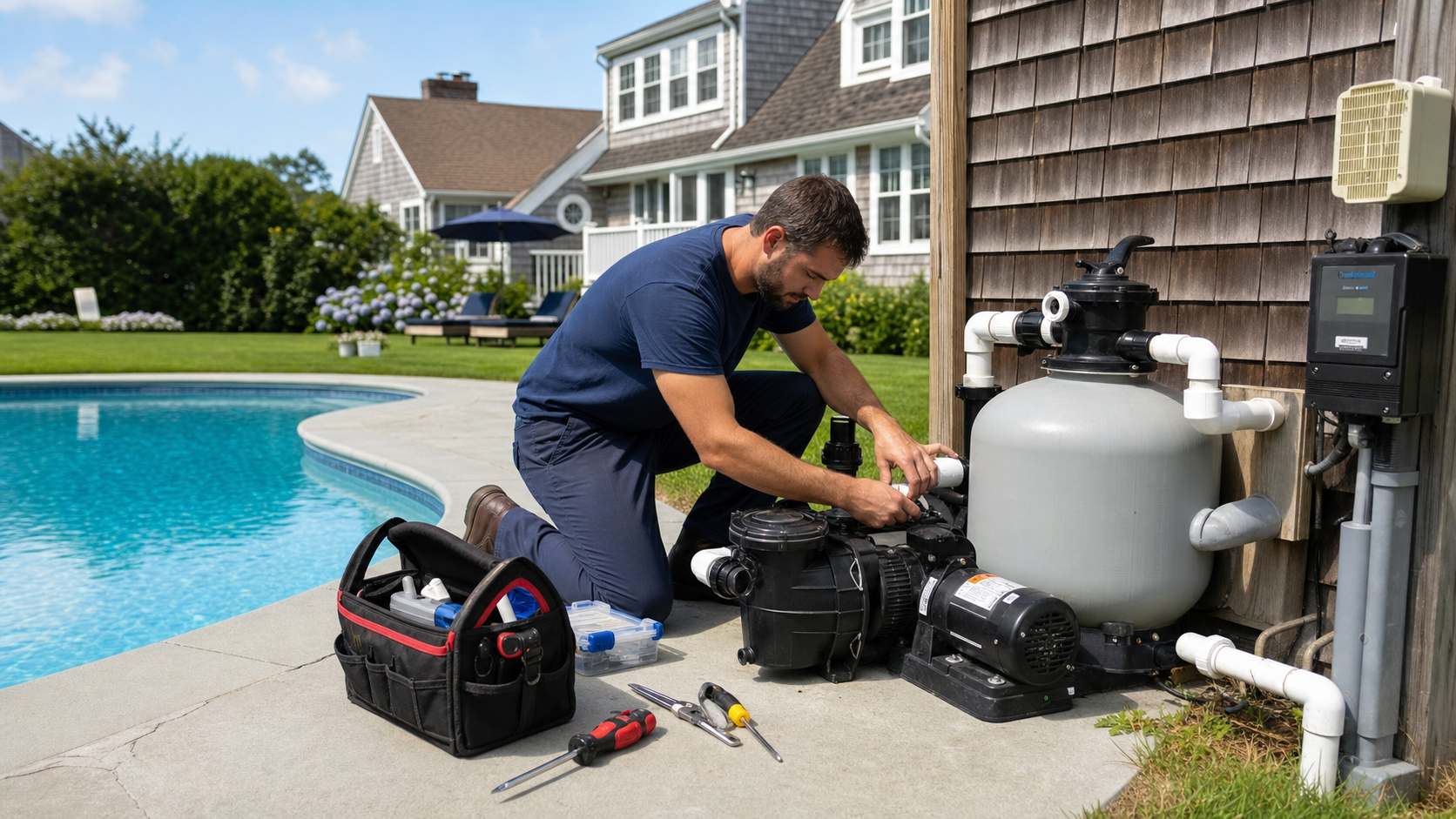
The pump is the most frequently serviced component in any inground pool system. On Cape Cod and the South Shore, where pools are opened and closed seasonally, pumps endure more thermal stress than those in warmer climates. Common pump repair scenarios include:
Pump Motor Burnout
If your pump hums but does not turn, or trips the circuit breaker repeatedly, the motor windings may have failed. On single-speed pumps common in older Cape Cod pools, full motor replacement typically runs $200–$400 in parts plus labor. Variable-speed pump motors cost more but qualify for energy rebates through Eversource and National Grid in Massachusetts.
Shaft Seal Leaks
A dripping pump housing indicates a worn shaft seal. If left unaddressed, water intrusion will destroy the motor bearings within weeks. Seal replacement is a straightforward repair—typically $80–$150—but requires draining and disassembling the pump wet end. This is a job most homeowners can DIY if comfortable with basic plumbing, but improper reassembly can create air leaks that reduce efficiency.
Cavitation and Airlocks
A pump that sounds like it’s eating gravel, or that rapidly loses prime after startup, is likely cavitating—pulling in air instead of water. Root causes include a cracked lid O-ring, loose union fittings, or a plugged skimmer. Our techs carry replacement O-rings and pressure-test unions on every service call to the Hyannis, Barnstable, and Yarmouth areas.
Pool Filter Repair and Media Replacement
Cape Cod and South Shore pools most commonly use sand filters, DE (diatomaceous earth) filters, or cartridge filters. Each type has its own failure modes.
Sand Filter Lateral Cracks
Sand that returns to the pool through the return jets signals a broken lateral or cracked standpipe inside the tank. Replacing a full lateral assembly costs $150–$300 in parts and requires a multi-hour service call. While disassembled, technicians also recommend replacing the sand if it has been in service more than 5–7 years.
DE Filter Grid Tears
DE powder returning to the pool means one or more filter grids have torn. Grid sets for a standard Pentair or Hayward DE filter run $120–$200 and should be replaced as a complete set. After repair, the filter requires a fresh charge of food-grade DE powder—approximately 1.5 lbs per 10 sq ft of filter area.
Multiport Valve Repair
The multiport valve controls backwash, rinse, and recirculate modes. A worn spider gasket allows water to bypass filter media or leak from the waste port. New spider gaskets run $20–$40 and are a simple DIY repair if you have the correct model number. Full valve replacement costs $150–$280 installed.
Pool Heater Repair on Cape Cod
Given Massachusetts’ short outdoor swimming season, a functioning heater is essential for extending enjoyment from May through October. We service gas, propane, and heat pump units throughout the Cape and Plymouth area.
Ignition and Pilot Failures
Gas heaters with intermittent pilot assemblies can fail to ignite due to a dirty pilot orifice, a failing igniter, or a faulty pressure switch. These repairs typically cost $150–$300. Always ensure your heater’s gas supply shutoff is accessible before calling—a simple closed valve accounts for more “heater failures” than any mechanical fault.
Heat Exchanger Scale Buildup
Hard water from Cape Cod’s municipal and well supplies can deposit calcium scale inside heat exchanger tubes, reducing efficiency and eventually causing cracking. Annual heater descaling ($100–$200) dramatically extends heater life and is especially recommended in Hyannis, Falmouth, and Yarmouth where water hardness levels are elevated.
AEO Quick Recap: Pool Equipment Repair FAQs
- How long does pool equipment repair take? Most single-component repairs complete within 1–3 hours. Parts availability is the main variable—our vans are stocked with high-turn Hayward, Pentair, and Jandy parts common on Cape Cod.
- Is pool pump repair worth it vs. replacement? If the motor is the only failed component and the pump body is in good condition, repair usually makes sense for pumps under 10 years old. Older single-speed pumps may be worth replacing with a variable-speed unit for long-term savings.
- Can I run the pool without a working pump? No. Stopping circulation allows algae and bacteria to grow rapidly. If your pump fails, address it within 24–48 hours or add an extra algaecide treatment to maintain water safety per CDC healthy swimming guidelines.
FAQ: Pool Equipment Repair on Cape Cod
What pool equipment brands do you service?
We service all major brands found on Cape Cod and South Shore pools, including Hayward, Pentair, Jandy, Sta-Rite, Zodiac, and Raypak. We carry OEM replacement parts for the most common models and can source specialty parts within 1–2 business days for less common equipment.
Do you offer emergency pool equipment repair?
Yes. We offer priority service for equipment failures that risk water quality or structural damage. Contact us through our contact page or call to schedule an urgent appointment.
How do I know if my pool pump needs repair vs. full replacement?
Key indicators that repair makes sense: pump body is intact, failure is limited to motor, seal, or basket. Key indicators that replacement makes sense: pump is over 12 years old, significant corrosion on housing, repeated failures within a single season, or the pump is a single-speed unit that would benefit from variable-speed efficiency gains.
What are typical pool equipment repair costs in Massachusetts?
Most individual equipment repairs in the Barnstable, Plymouth, and Yarmouth areas range from $80 to $600 depending on the component and parts required. Request a free estimate from Cape Cod Pool Repair’s quote page before authorizing any work.
Do you service pool automation systems?
Yes. We troubleshoot and repair Hayward OmniLogic, Pentair IntelliConnect, and Jandy iAquaLink automation systems. Automation faults commonly arise from lightning strikes, moisture intrusion, or firmware issues—all of which we diagnose on-site.
Schedule Pool Equipment Repair on Cape Cod
A malfunctioning pump, filter, or heater doesn’t have to ruin your Cape Cod pool season. Cape Cod Pool Repair serves homeowners and property managers across Hyannis, Barnstable, Yarmouth, Falmouth, Plymouth, and the wider South Shore. Our licensed technicians arrive stocked with the parts most likely needed to complete your repair on the first visit.
Visit our services page to learn more about everything we repair, or contact us today to schedule your service call. Don’t let a broken pump drain your summer—get it fixed fast with the team Cape Cod trusts.
Seasonal Equipment Considerations for Cape Cod Pool Owners
Because Cape Cod pools operate on a compressed seasonal schedule—typically Memorial Day through Labor Day with spring and fall extensions—equipment is subjected to the full cycle of startup, heavy use, and shutdown every year. This cyclical stress differs significantly from year-round pool operation in warmer climates and creates specific maintenance priorities for South Shore homeowners.
Spring Startup Equipment Checks
Before filling and running a pool for the season, our technicians perform a systematic equipment inspection that covers every component that sat dormant through winter. Pump seals dry out and crack during extended storage. Heater ignition systems and gas valves corrode. Salt cell electrodes scale up and lose efficiency. Filter multiport valves develop spider gasket failures from the cold. Catching these issues during the startup inspection—before the pool is filled and chemicals are balanced—is dramatically more efficient than diagnosing them mid-season.
Our startup checklist for Hyannis, Yarmouth, and Barnstable pools includes: pump prime test, pressure gauge reading, filter backwash cycle verification, heater ignition sequence, salt cell conductivity test, automation system function test, and a full pressure test of the plumbing system to rule out winter freeze damage to underground lines.
Mid-Season Performance Monitoring
Pool equipment operates most efficiently when monitored regularly rather than only when problems arise. Variable-speed pumps on newer installations include digital displays that show flow rates and energy consumption in real time—deviations from baseline indicate developing issues before they become failures. Filter pressure gauges tell you when it’s time to backwash (typically when pressure rises 8–10 psi above clean baseline). Salt cell displays show chlorine output and cell health. Building the habit of a weekly 5-minute equipment check prevents the majority of mid-season breakdowns.
Fall Closing Equipment Procedures
Proper fall closing of pool equipment is as important as the closing of the pool itself. All water must be removed from pump housings, filter tanks, heater headers, and plumbing lines to below the frost line before Massachusetts temperatures drop below freezing. Water left in equipment expands when it freezes and cracks pump impellers, filter tanks, and heater heat exchangers. Our closing service uses a commercial air blower to clear all lines and includes a thorough equipment inspection to identify any repairs that should be made before the following spring.
Choosing Quality Pool Equipment for Cape Cod Conditions
Not all pool equipment is created equal for New England climates. Cape Cod homeowners should consider the following when selecting replacement equipment:
Variable-Speed Pumps
Massachusetts state law now requires that new installations use variable-speed pumps, and the energy savings make retrofitting older single-speed systems worth considering. A variable-speed pump running at low speed for 12 hours uses far less electricity than a single-speed pump running at full speed for 8 hours—and provides equivalent water turnover. For homes in Barnstable, Hyannis, or Yarmouth on the Eversource or National Grid service territories, energy rebates for qualifying variable-speed pumps can offset a portion of the purchase cost.
UV and Ozone Supplemental Sanitation
UV and ozone systems reduce the chlorine demand of Cape Cod pools, which is especially valuable in saltwater pool systems where reducing chlorine generation extends salt cell life. UV systems pass pool water through an ultraviolet light chamber that neutralizes bacteria and some protozoa without chemicals. Ozone generators inject ozone into the return plumbing where it oxidizes contaminants before water re-enters the pool. Both technologies are additive—they supplement rather than replace chlorine—but can dramatically reduce overall chemical usage.
Equipment Pad Organization and Accessibility
A well-organized equipment pad simplifies every service call and reduces diagnostic time. When our technicians work on pools in Plymouth, Falmouth, or Yarmouth, access to unions, valves, and electrical disconnects determines how long even simple repairs take. We recommend installing unions on both sides of every piece of equipment, labeling all valves, and ensuring the equipment pad is accessible from at least two sides. This investment in organization pays dividends in faster, lower-cost service visits throughout the pool’s life.
For a complete overview of all repair and maintenance services available for your Cape Cod or South Shore pool, visit Cape Cod Pool Repair’s services page, or contact us to schedule a comprehensive equipment assessment.