Pool plaster doesn’t fail overnight. The deterioration is gradual — which makes it easy to rationalize waiting another season, then another. But knowing the specific signs that a Cape Cod pool surface has reached the end of its functional life helps you make the resurfacing decision at the right time: before the plaster begins causing damage beyond the surface itself. This guide covers the concrete warning signs that your Cape Cod pool needs professional resurfacing, why coastal New England accelerates plaster wear, what happens when resurfacing is delayed, and how to evaluate whether your pool is at the threshold.
The 7 Most Reliable Signs Your Cape Cod Pool Needs Resurfacing
Pool plaster shows deterioration in recognizable patterns. Here are the seven most reliable indicators that your pool surface is past its prime:
1. Rough texture that scratches feet and snags swimwear. A properly plastered pool feels smooth against bare skin. When plaster ages and begins to etch, the calcium carbonate surface matrix erodes away, exposing underlying sand and aggregate particles. The result feels like medium-grit sandpaper. Swimmers leaving with scratches on their feet or damaged swimsuits are giving you a direct feedback signal that the surface has deteriorated beyond cosmetic concerns. Rough surfaces also harbor algae more aggressively than smooth ones, driving up chemical consumption.
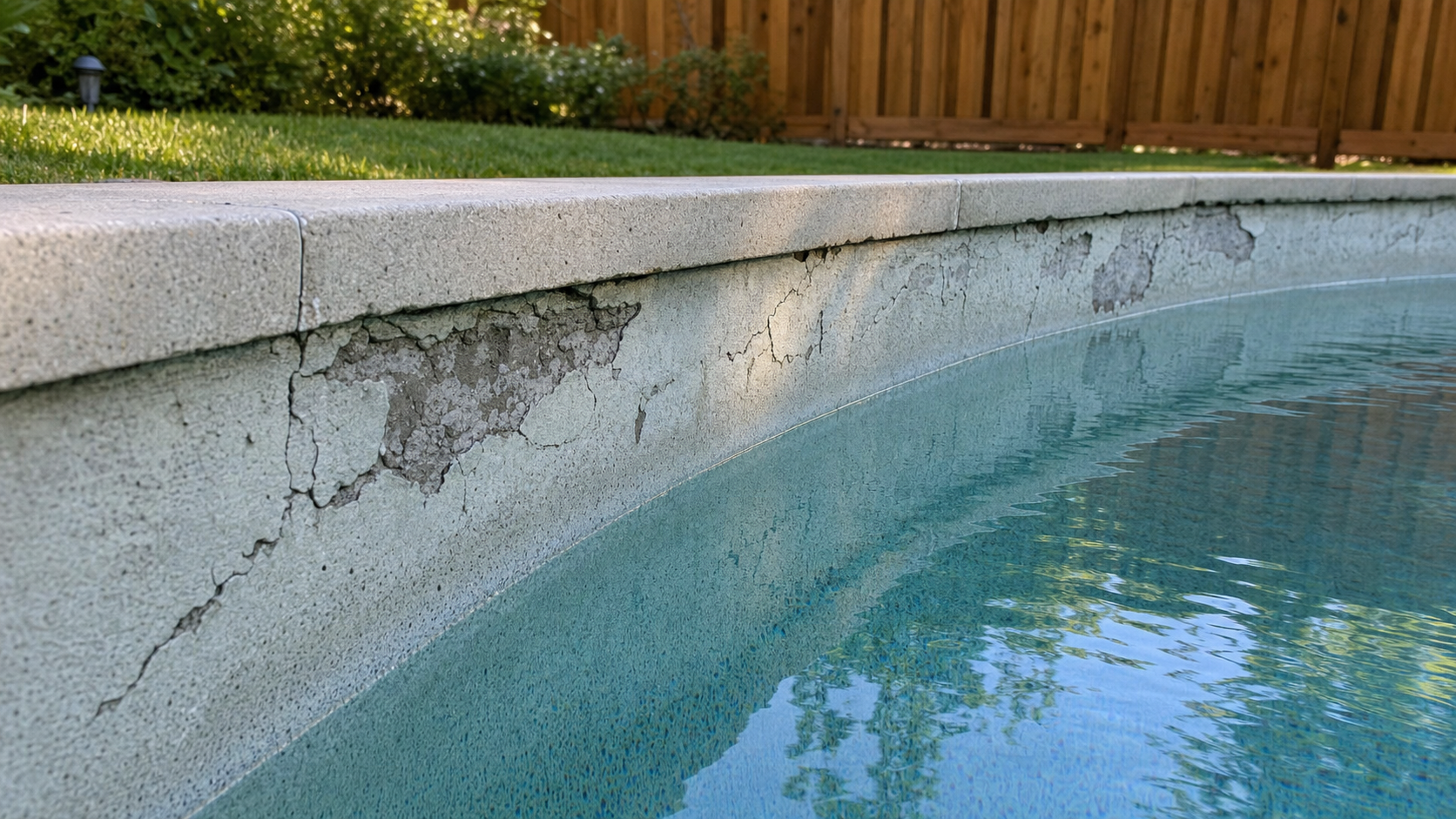
2. Visible etching and pitting. When you drain your pool and see obvious pitting, divots, and irregular texture across the plaster — particularly near the steps and floor where surface wear is greatest — the plaster has been chemically eroded. Low pH, low calcium hardness, and high water temperatures accelerate etching in plaster surfaces. Cape Cod’s compressed swim season intensity — high bather loads, high UV, significant chemical fluctuations — creates chemistry conditions that are particularly aggressive on aging plaster.
3. Chalky water after brushing. When brushing the pool walls or floor raises a visible white cloud that takes time to clear, the plaster is shedding calcium carbonate powder. The surface is literally dissolving into the water. Each brushing removes surface material. At this stage, the plaster is actively failing.
4. Cracks in the plaster surface. Fine hairline cracks (crazing) are common in aging plaster and indicate that the surface has lost its tensile flexibility. More concerning are map cracks (networks of interconnected cracks) and structural cracks that follow lines of potential movement. On Cape Cod, freeze-thaw cycling is the most common cause of crack propagation. Water enters hairline cracks, freezes, and expands the crack with each winter cycle.
5. Staining that doesn’t respond to treatment. Brown, grey, or dark staining that persists after acid washing or chemical treatment indicates that stains have penetrated into the plaster matrix — the plaster is porous enough to absorb and retain contaminants. At this stage, the only lasting remedy is resurfacing.
6. Delamination (plaster separating from the shell). Tap the pool surface in areas that look raised or irregular — a hollow sound indicates the plaster has separated from the underlying gunite shell. Delaminated sections will eventually fall off, leaving the gunite shell exposed to water and progressive erosion. This requires immediate attention.
7. Pool age over 12 years without resurfacing. Even without obvious symptoms, a plaster surface older than 12 years in a Cape Cod pool warrants professional inspection. Most standard plaster has a functional life of 10–15 years in ideal conditions; Cape Cod’s salt air and freeze-thaw environment tends to put pools at the lower end of that range. A professional assessment gives you an honest picture of remaining surface life.
Why Cape Cod Accelerates Plaster Deterioration
National plaster lifespan averages — typically cited as 10–15 years — are based on pools in temperate, non-coastal environments. Cape Cod pools face a more demanding set of conditions:
Freeze-thaw cycling. Cape Cod winters deliver 30 to 70 freeze-thaw cycles per season. Water infiltrating any surface crack or pore expands 9% when it freezes, widening microscopic damage cumulatively over 10 to 15 winters. This compresses what would be a 15-year plaster life in an inland pool to 10–12 years on Cape Cod.
Salt air exposure. Airborne salt particles accelerate the degradation of the surface layer of pool plaster. Pools within a mile of tidal water face the most aggressive salt air conditions. Barnstable Harbor, Hyannis Port, and the Nantucket Sound shore see the highest salt air exposure levels in the region.
Compressed seasonal use intensity. Cape Cod pools get more use in 10 weeks than many southern pools get in an entire year. Heavy bather loads, intense UV, and significant chemical stress during peak season all accelerate surface wear. This intensity combined with the off-season freeze-thaw stress creates a cycle that shortens plaster life more than either factor alone would.
The Cost of Delaying Resurfacing
Year 1 of deferral: surface roughness and mild cracking present. Normal prep and resurfacing are still feasible. Years 2–3: delamination begins, cracks worsen, water infiltrates the shell. Pre-plaster shell repair cost adds $500–$2,000. Years 4–5+: possible rebar corrosion, shell erosion, structural repairs needed. The project transitions from a $5,000–$9,000 resurfacing job to a $12,000–$25,000 renovation.
If your pool is showing any of the signs described above, now is the right time for a professional assessment. Visit our Cape Cod pool services page, browse our complete pool services catalog, or request a free surface assessment today.
Our Commitment to Cape Cod and South Shore Pool Owners
Cape Cod Pool Repair is based at 100 Independence Drive, Hyannis, MA 02601. We are a locally owned and operated pool repair and renovation company serving Cape Cod and the South Shore — not a national franchise. All work is performed by our own trained crew, and every project begins with a free on-site assessment and written estimate. We don’t start work until you’ve reviewed and approved our proposal.
Our service area covers all of Cape Cod including Barnstable, Falmouth, Sandwich, Yarmouth, Dennis, Harwich, and Chatham, as well as South Shore communities including Plymouth, Hingham, Quincy, and Brockton. We’re reachable at (508) 348-9990 Monday through Friday 8:00 AM to 5:00 PM and Saturday 9:00 AM to 2:00 PM. Submit service requests online at https://capecodpoolrepair.com/get-a-quote/ at any time — we respond within one business day.
Browse our complete pool services catalog to see the full range of repair, renovation, and maintenance services we offer throughout Cape Cod and the South Shore. Whether your project is a simple seasonal opening, a targeted tile repair, or a comprehensive pool renovation, Cape Cod Pool Repair has the experience and equipment to handle it professionally.
Our Process: What to Expect from Cape Cod Pool Repair
Cape Cod Pool Repair serves Cape Cod and the South Shore from our base at 100 Independence Drive, Hyannis, MA 02601. Every project starts with a free on-site assessment — we visit the property, inspect the pool, and provide a written estimate with transparent pricing before any commitment is required. We perform all work with our own trained crew, and we stand behind our work with clear warranty terms. Our service hours are Monday through Friday 8:00 AM to 5:00 PM and Saturday 9:00 AM to 2:00 PM. Call (508) 348-9990, email info@capecodpoolrepair.com, or submit a request online at https://capecodpoolrepair.com/get-a-quote/ at any time — we respond to all online requests within one business day.
We serve all of Cape Cod including Barnstable, Falmouth, Sandwich, Yarmouth, Dennis, Harwich, Chatham, and all surrounding villages, plus South Shore communities including Plymouth, Hingham, Quincy, and Brockton. All service is performed by our own professional crew. Browse our complete pool services catalog to see everything we offer, or visit our Cape Cod and South Shore service area pages for location-specific information.
Cape Cod Pool Repair is located at 100 Independence Drive, Hyannis, MA 02601. We’re available Monday through Friday 8:00 AM to 5:00 PM and Saturday 9:00 AM to 2:00 PM. Pool surface assessments are free and include no-obligation written estimates. Our team has assessed hundreds of Cape Cod and South Shore pools and will give you an honest evaluation of your pool’s resurfacing timeline. Call (508) 348-9990 or visit capecodpoolrepair.com to get started — and explore our full range of pool repair and renovation services to address any other issues your pool may need attention.
Whether you’re in Barnstable, Falmouth, Yarmouth, Sandwich, Plymouth, Hingham, or anywhere in our service area, Cape Cod Pool Repair is ready to assess your pool surface and give you an honest recommendation. Pool resurfacing is a significant investment and an important one — done at the right time with the right material, it sets your pool up for 10 to 20 years of dependable service. Delayed too long, it results in a larger, more expensive project. The right time to act is when the signs described in this guide are present. Don’t wait another Cape Cod winter to compound existing surface damage.
Frequently Asked Questions
How do I know my pool needs resurfacing vs. just cleaning?
Persistent rough texture that scratches swimmers’ feet, etching and pitting visible when the pool is drained, chalky plaster that clouds the water when brushed, cracks that extend into the plaster, and delamination (hollow sections) all indicate surface deterioration beyond what cleaning can address. Cleaning addresses surface contamination; resurfacing addresses surface structure. If your plaster is physically deteriorated — rough, cracked, delaminating — no amount of cleaning will restore it.
How much does pool resurfacing cost on Cape Cod?
Pool resurfacing on Cape Cod costs $4,000 to $14,000+ depending on pool size and surface material. Standard plaster is $5–$8 per sq ft installed. Quartz aggregate runs $9–$14 per sq ft. Premium pebble finishes cost $13–$18 per sq ft. Most standard 16×32 pools cost $5,000–$9,000 for resurfacing. Cape Cod Pool Repair provides free surface assessments — call (508) 348-9990.
What happens if I wait too long to resurface my pool?
Delayed resurfacing allows damage to compound. Porous plaster allows water to infiltrate the gunite shell, accelerating concrete erosion and potentially initiating rebar corrosion. Rough surfaces harbor algae more aggressively, driving up chemical use. In advanced cases, more extensive shell repair is required before new plaster can be applied, significantly increasing total project cost. Early resurfacing is almost always less expensive than late resurfacing.
Can I resurface just part of my pool?
Partial resurfacing is technically possible but rarely produces good results long-term. New plaster applied over a partially prepared surface cures differently and often shows visible color and texture differences. The patch-to-existing joint is a common future failure point. Cape Cod Pool Repair recommends full resurfacing when the pool surface has deteriorated to the point where resurfacing is warranted — results are superior and longevity is far better than patches.
Does Cape Cod Pool Repair offer free resurfacing assessments?
Yes — Cape Cod Pool Repair provides free on-site surface assessments throughout Cape Cod and the South Shore. During the assessment, we inspect the plaster surface condition, check for structural issues in the gunite shell, assess tile and coping condition, and provide a written recommendation and cost estimate. No obligation. Call (508) 348-9990 or request online at capecodpoolrepair.com/get-a-quote/.
Ready to schedule your pool resurfacing?
Cape Cod Pool Repair serves Cape Cod and South Shore MA from our Hyannis location.
- 📞 (508) 348-9990
- 📧 info@capecodpoolrepair.com
- 📍 100 Independence Drive, Hyannis, MA 02601
- 🕐 Mon–Fri 8:00 AM – 5:00 PM | Sat 9:00 AM – 2:00 PM